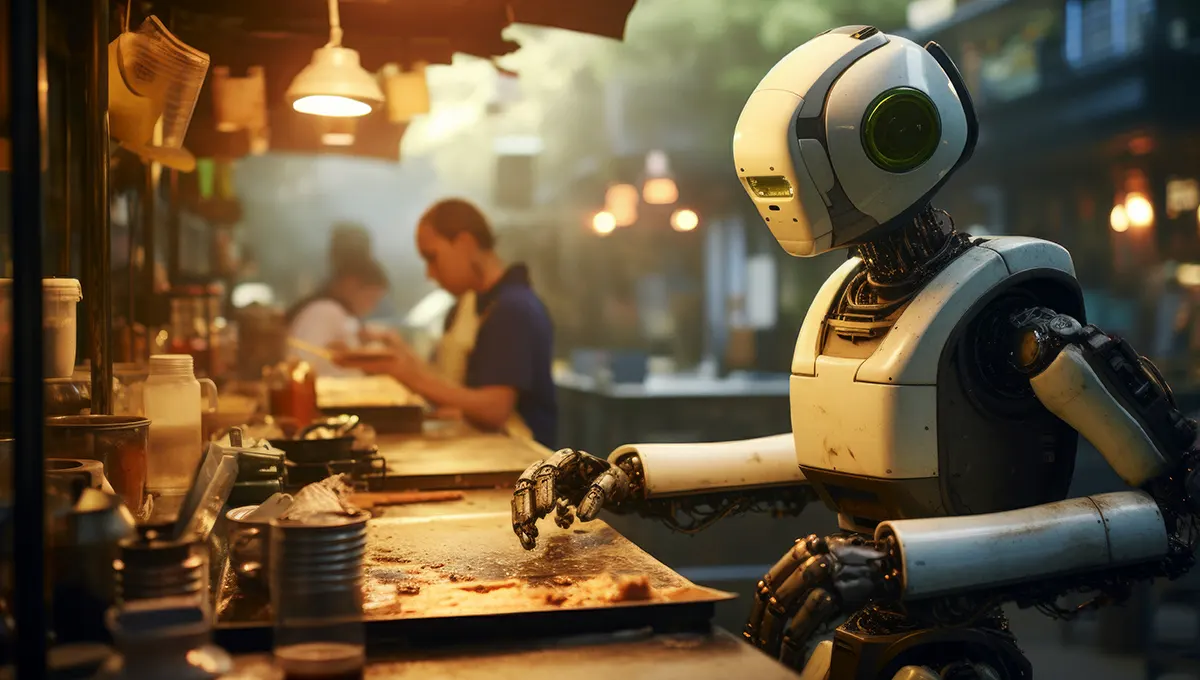
AI Robots Transforming Human Life with Smart Technology and Automation
This machine does the cleaning for itself. This robot arm constructs a car. This digital assistant provides live responses. AI robots are not futuristic fantasies anymore; they have been a reality already.
In 2026, the total value of the global AI Robots market was estimated at $20 to $29 billion and is projected to grow up to $124.26 billion by 2034. Such growth means there must be some changes happening in real life.
In this guide, you will find out everything about AI robots including what they are, types, working principles, application areas, and more.
What Are AI Robots?
AI robots are a type of robot that integrates a physical machine and an intelligent system to see, think, and act independently, with little to no human guidance.
The old-fashioned robot is like the record player that does nothing but play what you put into it; on the contrary, AI robots are like musicians that improvise their playing depending on what they hear.
Components of Robot Technology
Robot technology relies on a complex interplay of four systems:
- Sensors and Computer Vision Systems for object recognition and movement detection
- Machine Learning and Artificial Intelligence for better performance with time
- Movement Systems and Actuators for translating digital signals into movements
- Data Processing Systems for analyzing data instantly
All of these constitute the core elements of modern robot technology.
Types of AI Robots You Should Know
1. Humanoid Robot
Humanoid robots are modeled after humans not only in shape but also in behavior. They have evolved from research labs to industrial environments. Boston Dynamics created Atlas which is an electric version of the robot made for industrial use, and robots of Figure AI started their full-time duty in a BMW factory four times faster than previous models. It's expected that many millions of humanoid robots will be used around the world in ten years' time.
2. Assistant Robot
Assistant robots deal with the things that used to require human intervention such as handling questions, scheduling appointments, and executing requests. In companies, they increase efficiency and save money by being utilized in customer support services, office automation, and hospitality industry. Amazon Alexa voice assistant is just the beginning of this trend.
3. Robots for Smart Homes
Robots for smart homes are making people’s lives easier. Some examples of such robots are iRobot Roomba. These robots can perform functions like lawn mowing, security duties, and even cooking in the kitchen. In 2024, the market value of household robots reached $12.18 billion, and it will rise to more than $71 billion by 2034.
4. Companion Robots
Companion robots act as a source of comfort to humans emotionally and socially. By 2025, around 620,000 AI-based robots assisted in nursing care centers, providing them with companionship and health status updates.
Human Robot Interaction How Humans and AI Robots Work Together
The relationship between humans and robots can be referred to as HRI, which stands for Human Robot Interaction. Artificial Intelligence technology has made a great improvement in this field through voice recognition, emotional understanding, and prompt response.
As far as manufacturing goes, cobots function hand-in-hand with human beings doing tedious and risky jobs while humans do high-value jobs. Scientists such as Ken Goldberg of the University of California, Berkeley, have been working for decades trying to prove that cooperation yields the best results.
Real-World Applications of AI Robots
Health Care
Robot-assisted surgical systems aid with precision surgeries. Autonomous robots provide drugs from one floor to another in the hospitals. AI-enabled robots have saved patient waiting time by 18.4% in large hospitals. The medical robots market is forecasted to touch $64.36 billion by 2034.
Manufacturing & Logistics
The Amazon robotics unit employs hundreds of thousands of robots in its fulfillment centers. This reduces operating expenses by 30-40%. AI robots provide an order accuracy rate of 99.5%.
Personal & Home Use
From robot cleaning machines to AI robots that help maintain the security of your home, all kinds of robotic assistance are available for personal use. As these machines become affordable and more capable, the adoption of robotics in homes is increasing.
Benefits of AI Robots
- Increased efficiency: Robots work continuously without fatigue
- Reduced human error:vCritical in surgery, manufacturing, and logistics
- 24/7 availability: No breaks, no downtime
- Enhanced safety: Robots handle hazardous environments humans shouldn't enter
Challenges and Limitations of AI Robots
Here are some of the practical challenges of AI robots that should not be overlooked:
- Expensive: They can be costly to develop and implement, especially for small firms
- Technological constraints: Even sophisticated robots cannot perform delicate actions such as doing laundry
- Ethical issues: Issues regarding data privacy and decision-making by robots must be addressed
- Unemployment: According to Oxford University research, almost 47% of all jobs are theoretically automatable
It’s progressing fast yet, limitations exist.
The Future of AI Robots
There was a fivefold increase in the investments made in general-purpose robotics from 2022 to 2024. There is now a development where generative AI is being integrated within robots, allowing robots to perform complex commands provided in natural language.
Humanoid robots are being moved from experimental trials to manufacturing plants. According to Andrew Ng, an AI expert, AI and robotics constitute one of the biggest technological breakthroughs in history. Future AI robots will not only perform tasks but will be able to think and cooperate.
Conclusion
These robots have long been out of the laboratory and continue making progress. Used in healthcare facilities, private homes, and manufacturing plants, smart machines change our way of life.
Technology continues progressing rapidly, huge amounts of money have been invested in research and development projects, and we can see the fruits today.
This article will be interesting not only for a person who simply wants to learn more about AI robots but also for entrepreneurs working with such technology. Visit the MIT CSAIL website or browse through IEEE Spectrum Robotics articles to know more.
FAQ’s
-
Are there any real AI robots?
Yes, AI robots exist today and are used in healthcare, manufacturing, and homes. They can learn, adapt, and perform tasks using advanced robot technology systems. - Which 3 jobs will survive AI?
Jobs requiring creativity, emotional intelligence, and complex decision-making will survive AI. Examples include healthcare professionals, creative roles, and leadership positions involving human judgment and interaction.
- What is the best AI robot in the world?
The best AI robot depends on use. Humanoid robots and advanced robot assistants lead innovation, offering human-like interaction, learning abilities, and real-world applications across industries.
- How much does Elon Musk's AI robot cost?
Elon Musk’s humanoid robot, Tesla Optimus, is expected to cost around $20,000 to $30,000, though pricing may change as robot technology advances and production scales.